

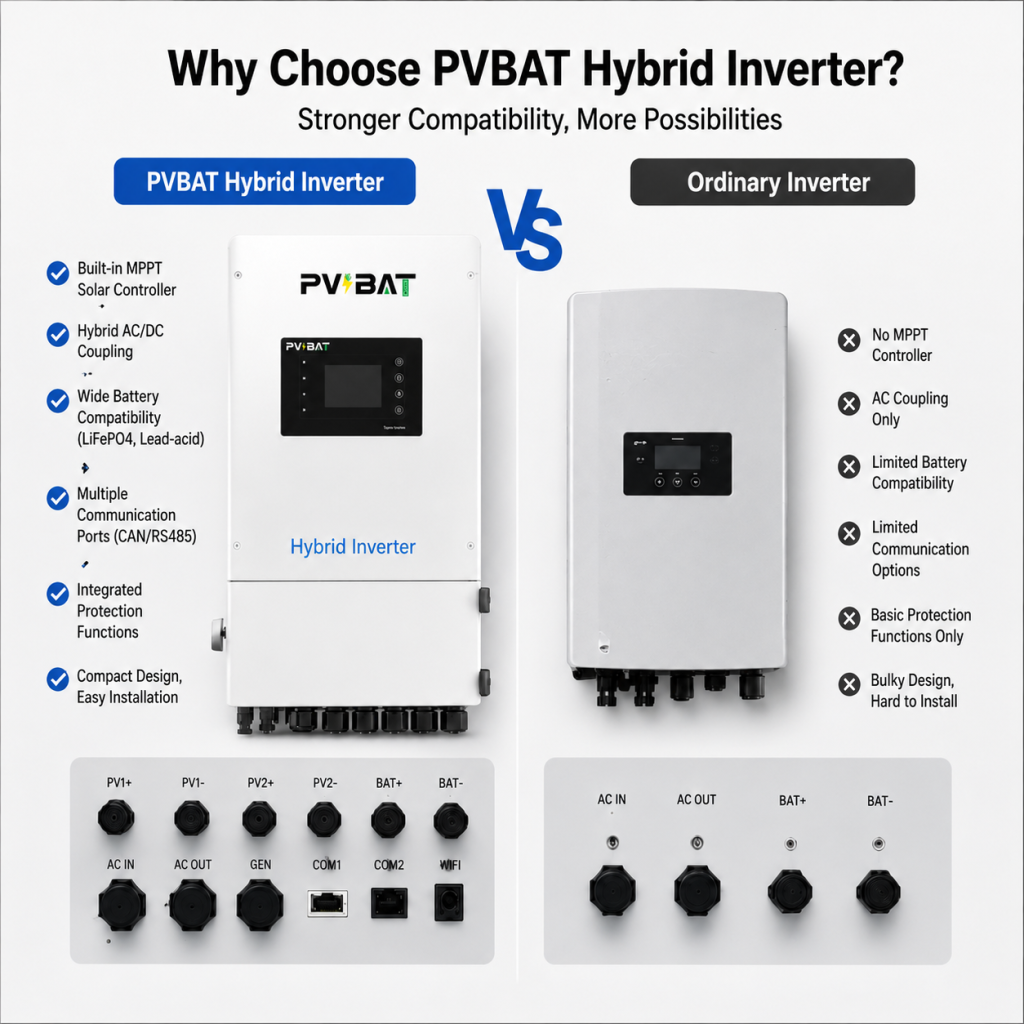
In the energy storage market, there is a wide variety of inverter products available. Users often overlook the differences between standard inverters and hybrid inverters. Many users make uninformed choices, resulting in their energy needs not being met and even leading to a waste of resources. Today, through a real-world comparison, we will analyze the core differences between PVBAT hybrid inverters and standard inverters to help users clarify their needs and select the energy storage core equipment that best suits them. We will also provide a comparative evaluation of inverters to assist users in choosing high-quality hybrid inverters.
Difference 1: Functionality. Conventional inverters only perform a single conversion—“PV power generation to AC electricity”—and cannot support energy storage or backup power supply. When the PV system is not generating power, users must rely on the grid, making them unable to handle power outages and limiting their practicality; In contrast, PVBAT hybrid inverters integrate four key functions: PV charging, battery storage, grid interaction, and backup power supply. They enable closed-loop management of “self-generation and self-consumption, surplus power storage, and emergency backup,” perfectly meeting the diverse energy needs of households and serving as the epitome of multifunctional hybrid inverters.
Difference 2: Level of Intelligence. Most conventional inverters lack intelligent control systems, making them unable to automatically adjust power generation output or power supply priorities. They require manual intervention, involve cumbersome operations, and demand a certain level of technical expertise from users; The PVBAT hybrid inverter features a built-in intelligent control system, equipped with an LCD touchscreen and a mobile app for monitoring. It displays real-time operational data, automatically optimizes power supply priorities among PV, the grid, and the battery, and supports switching between multiple operating modes. It requires no manual intervention, is easy to operate, even for beginners, highlighting the advantages of smart hybrid inverters.
Difference 3: Compatibility and Scalability. Most standard inverters are compatible only with specific types and capacities of batteries and solar panels, offering poor scalability. They cannot be expanded to meet user needs, resulting in high costs for future upgrades; The PVBAT hybrid inverter is compatible with various battery types, including lead-acid and lithium batteries, and supports parallel operation of multiple units. It allows for flexible expansion based on the PV system’s power output and electricity demand, making it suitable for households of different sizes and energy needs. With more convenient future upgrades, it is the preferred choice for highly scalable inverters.
Difference 4: Safety and Reliability. Conventional inverters have inadequate protection mechanisms, making them prone to issues such as overcurrent, overvoltage, and overheating, which can shorten equipment lifespan and even pose safety hazards; PVBAT hybrid inverters feature built-in multi-layer protection mechanisms against overcurrent, overvoltage, overheating, short circuits, and ground faults. They comply with international safety standards, undergo rigorous quality testing, and offer a long service life. Additionally, they provide comprehensive after-sales support, ensuring greater peace of mind and making them the safest and most reliable hybrid inverters.
Through this comparison, it is evident that the distinction between PVBAT hybrid inverters and standard inverters lies not only in the comprehensiveness of their features but also in their precise understanding of user needs and strict control over product quality. As such, they are the ideal core inverters for home energy storage systems.