
For scenarios with high power demands, such as medium-to-large households and small commercial spaces, the capacity of a single lithium-ion battery is often insufficient. In such cases, multiple lithium-ion batteries must be connected in parallel to increase capacity. However, connecting lithium-ion batteries in parallel requires strict adherence to wiring standards, address configuration, and device compatibility; improper operation can easily lead to uneven charge distribution among batteries, communication failures, or even equipment damage. The PVBAT 48V 628Ah lithium-ion battery supports multi-module parallel operation. Combined with a detailed lithium-ion battery parallel connection guide, it allows users to expand capacity with confidence, ensuring stable and efficient system operation and helping users achieve energy storage capacity expansion.
First, preparations before parallel connection. Ensure that all lithium batteries to be connected in parallel are of the PVBAT 48V 628Ah model. Avoid mixing different models or brands of lithium batteries (which can easily lead to charge imbalance and affect battery life). Check the status of each lithium battery to ensure there are no faults or damage, and that the SOC (State of Charge) is consistent (it is recommended to charge them all to 60%-80%). Prepare dedicated parallel connection boxes, circuit breakers, and communication cables, ensuring the cable specifications meet requirements (refer to the manual for recommended specifications) to avoid safety hazards caused by incompatible cables, and complete preparations for lithium battery parallel connection.
Second, the parallel connection wiring procedure. Move all lithium batteries to the installation location, ensuring the installation surface is level and secure, and leaving sufficient space for heat dissipation to prevent battery overheating; Using the junction box and circuit breakers, connect the positive and negative terminals of multiple lithium-ion batteries in parallel. Strictly distinguish between positive and negative terminals during wiring to prevent reverse connection; connect the communication cables in the order of “Host Link Port OUT → Slave Link Port IN,” connecting all paralleled batteries sequentially. Ensure all connections are secure and free of looseness to prevent poor contact, and perform the lithium-ion battery parallel wiring according to standard procedures.
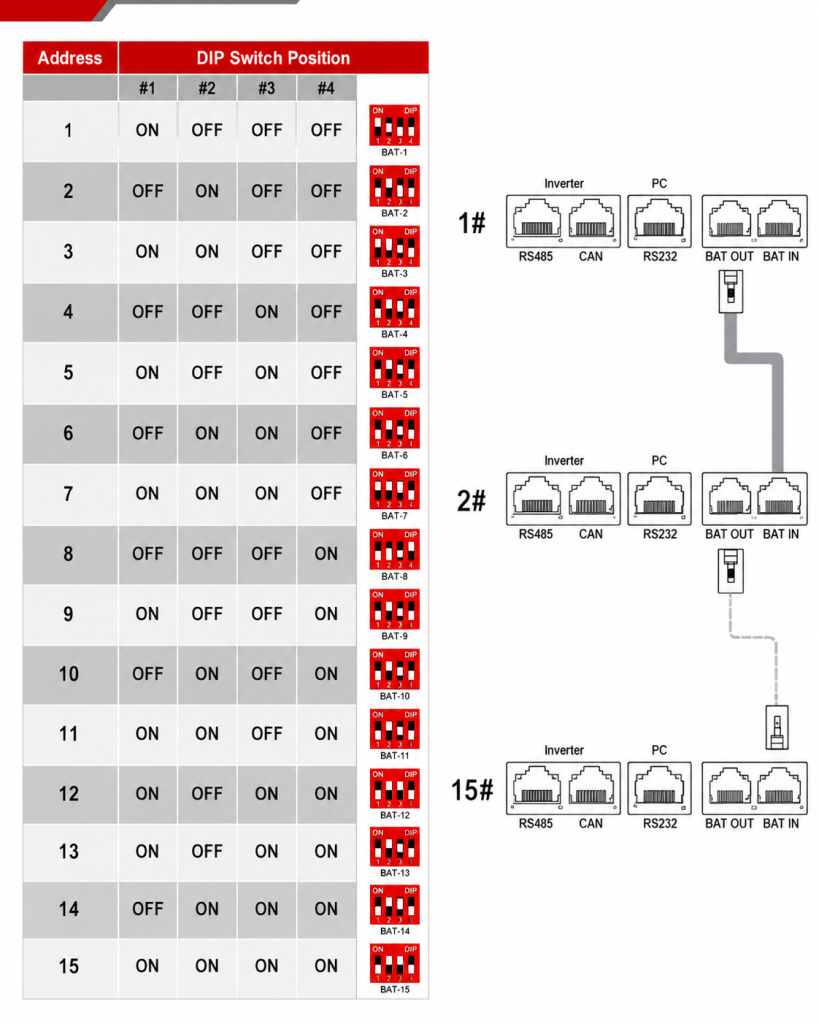
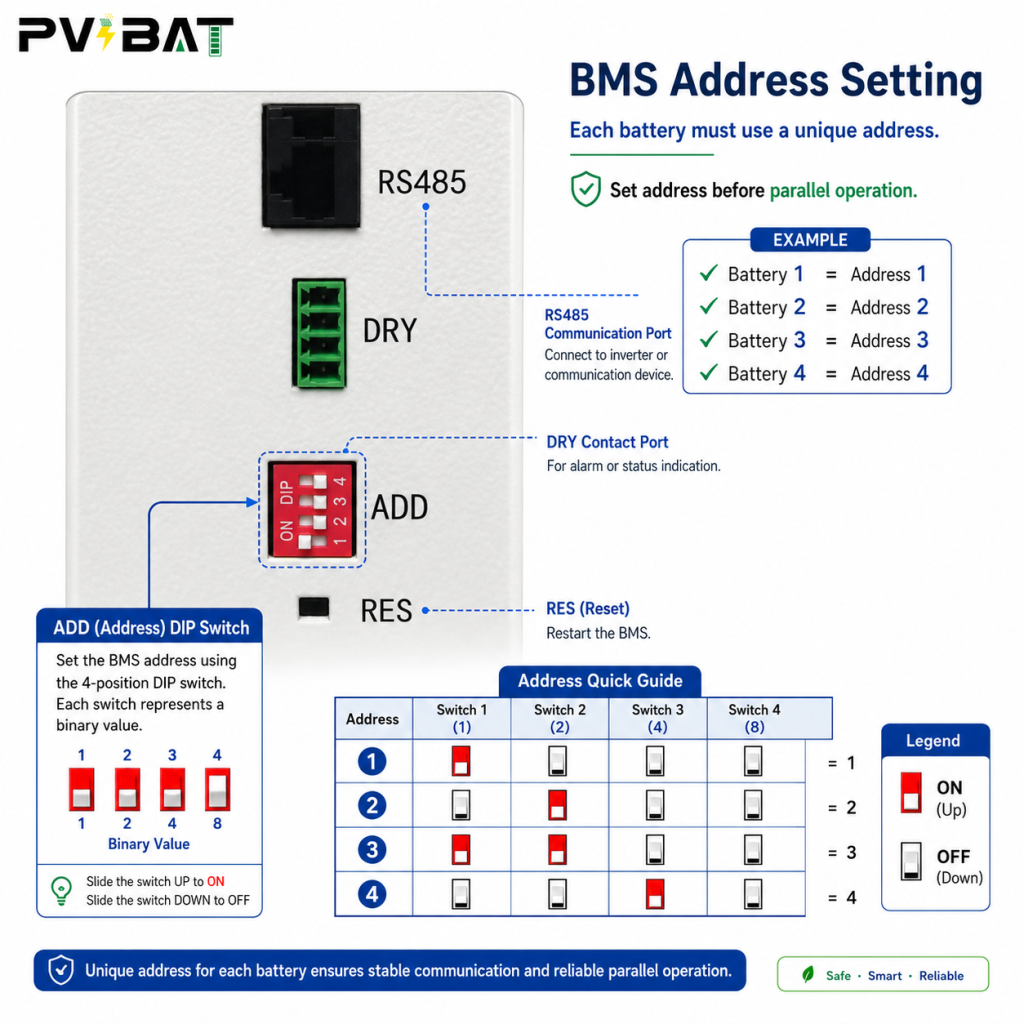
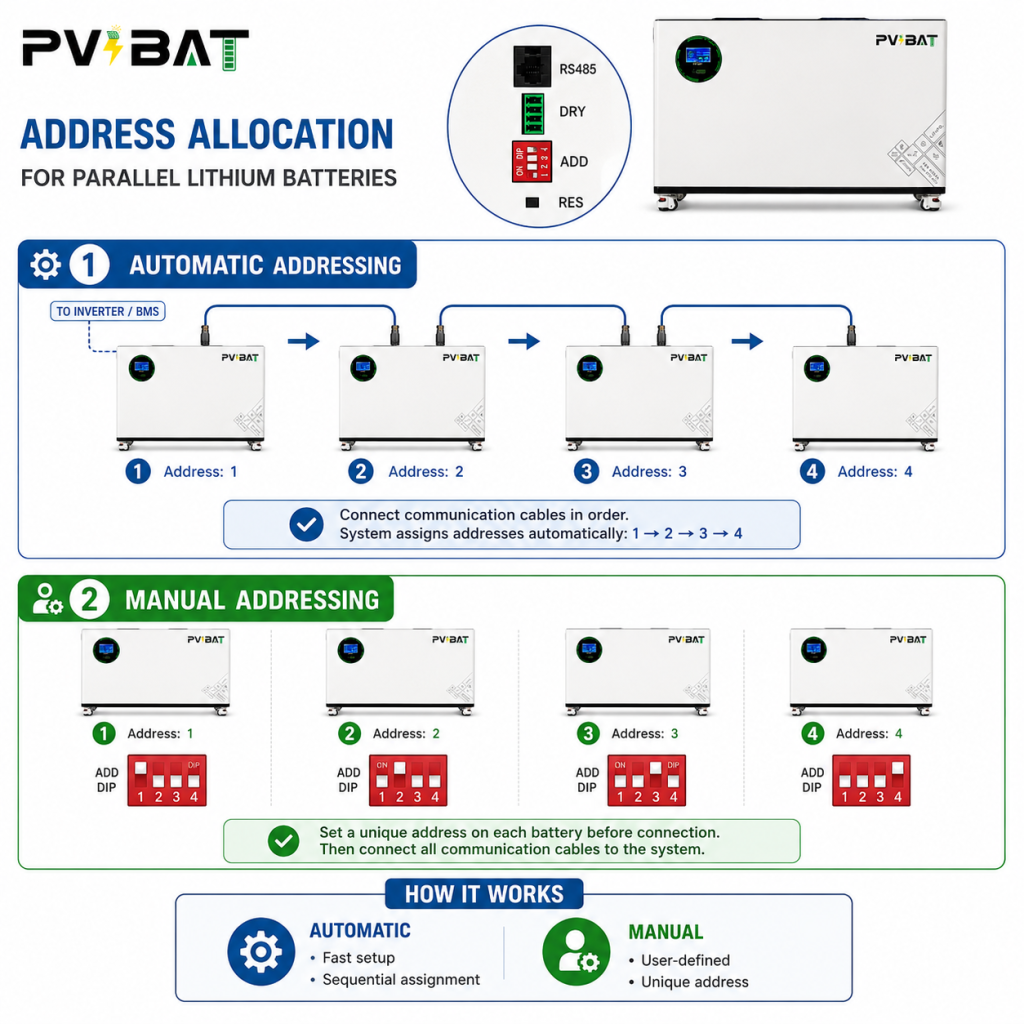
Next, configure the addresses. When multiple batteries are used in parallel, set the addresses via the DIP switches on the BMS to distinguish between different battery modules and avoid address conflicts (refer to the manual for DIP switch settings; addresses 1–20 can be freely selected). Alternatively, you can use the automatic DIP switch function: set all battery DIP switches to the “OFF” position, connect the communication cables, and power on the system. The master unit will automatically assign addresses, eliminating the need for manual configuration. This method offers greater convenience, reduces the likelihood of errors, and ensures proper address setup for the parallel-connected lithium-ion batteries.
Finally, perform post-parallel connection debugging. After connection is complete, power on the system to check the communication status of all batteries and ensure there are no communication faults; check the SOC and voltage of each battery to ensure power balance; run the system for a period of time to check the battery charge and discharge status, ensuring the parallel system operates stably and efficiently. If any abnormalities occur, promptly check the wiring and address settings, or contact a PVBAT after-sales engineer for assistance to ensure proper debugging of the lithium battery parallel system.