

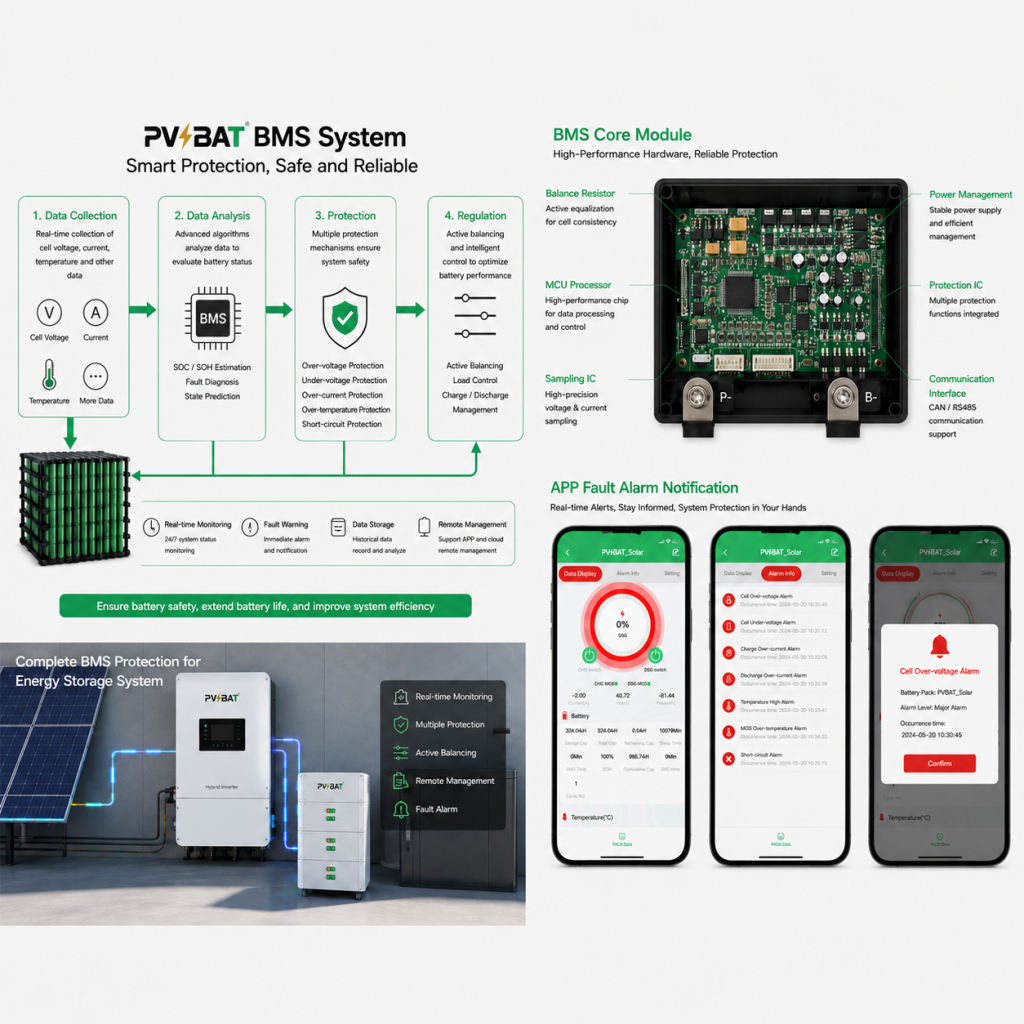
The safe operation of lithium-ion batteries relies heavily on the core BMS (Battery Management System)—it acts as the “brain” of the battery, responsible for real-time monitoring of battery status, adjusting charge and discharge parameters, and preventing safety hazards. When selecting lithium-ion batteries, many users often focus solely on capacity and price, overlooking the importance of the BMS system. This can ultimately lead to issues such as overcharging, over-discharging, and swelling, shortening the battery’s lifespan and even causing safety incidents. The intelligent BMS system built into PVBAT lithium-ion batteries, with its precise monitoring and comprehensive protection features, serves as the cornerstone of safe battery operation. It is also one of PVBAT’s core technologies, highlighting the advantages of the intelligent BMS battery management system.
The core advantage of the PVBAT lithium-ion battery BMS system is first and foremost its “comprehensive monitoring.” It collects key data such as battery voltage, current, temperature, and SOC (State of Charge) in real time to accurately assess the battery’s operational status. Upon detecting any abnormalities (such as excessive voltage or temperature), it immediately triggers protective mechanisms to halt charging or discharging, thereby preventing battery damage. Taking a 48V 628Ah lithium-ion battery as an example, its BMS system can monitor the status of each individual cell in real time, ensuring voltage balancing among cells and preventing overcharging or over-discharging of any single cell. This effectively extends the overall battery life and enables long-term, reliable operation of the lithium-ion battery.
Secondly, it features “intelligent adjustment.” The BMS system automatically adjusts the charging and discharging currents and voltages based on the battery’s operating status and ambient temperature, ensuring the battery operates under optimal parameters. For example, in low-temperature environments, it automatically reduces the charging current to prevent damage caused by charging at low temperatures; when the battery is nearly fully charged, it automatically switches to float charging mode to prevent overcharging, while compensating for self-discharge to maintain stable battery capacity, demonstrating the advantages of intelligent BMS regulation.
Furthermore, the PVBAT lithium-ion battery BMS system also features “communication compatibility” and “fault alarm” functions. It supports mainstream communication protocols such as CAN and RS485, enabling seamless integration with PVBAT inverters and inverters from other brands to achieve coordinated system operation. When a battery fault occurs (such as a short circuit or cell failure), it sends alarm signals via LED indicators and the app, promptly alerting users to address the issue, thereby preventing safety hazards from escalating and ensuring the safety of the energy storage lithium-ion batteries.
From an industry perspective, the well-designed PVBAT BMS system not only enhances the safety and service life of lithium-ion batteries but also drives the standardization of the energy storage battery industry. By providing users with more reliable energy storage solutions, it has become a benchmark for lithium-ion battery BMS systems.