

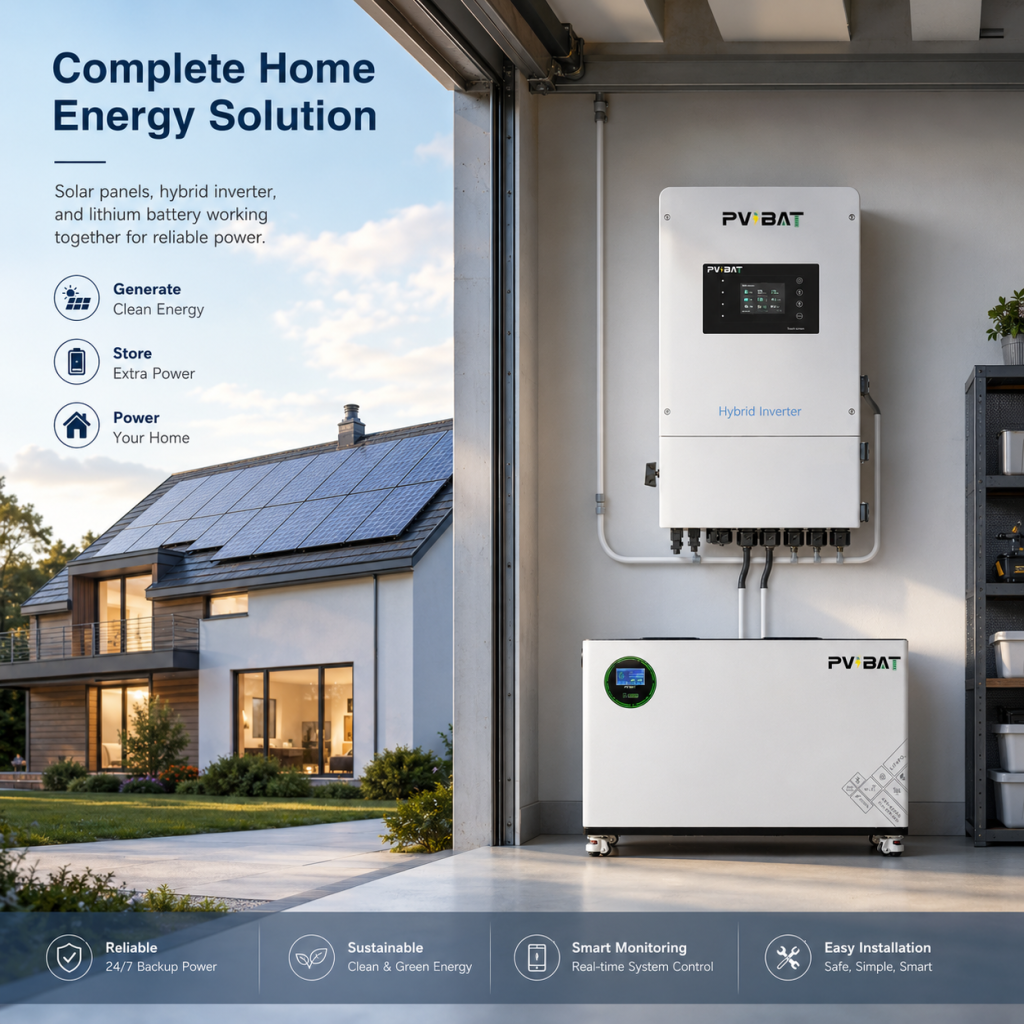
Power outages are unexpected events that both residential and commercial users may face, especially during summer peak demand periods or severe weather conditions such as heavy rains and typhoons. Power outages not only disrupt daily life and business operations but can also result in significant financial losses. To verify the emergency power supply capabilities of the PVBAT energy storage system, we conducted real-world field tests to determine whether it can truly meet power demands during outages and provide users with peace of mind. This emergency power supply test focused on validating the PVBAT’s emergency power capabilities, offering a reference for users selecting emergency energy storage equipment.
Test Scenario 1: Residential Emergency Power Supply (using a PVBAT 6kW hybrid inverter + 48V 628Ah lithium battery). Simulating a typical household power usage scenario, we connected loads such as a refrigerator, air conditioner (1.5 HP), desk lamp, and computer, with a total load power of approximately 3 kW. After the grid power was manually disconnected, the inverter rapidly switched to backup power mode in less than 0.5 seconds, with no noticeable power interruption, and all loads continued to operate normally. During the continuous power supply test, with the battery fully charged, it provided stable power for approximately 10 hours, fully meeting a household’s normal daily power needs. This effectively prevented issues such as food spoilage in the refrigerator and air conditioner shutdown caused by power outages, demonstrating the advantages of residential emergency energy storage.
Test Scenario 2: Commercial Emergency Power Supply (using a PVBAT 12kW hybrid inverter paired with two 48V 628Ah lithium-ion batteries in parallel). Simulating a convenience store power usage scenario, the system connects to loads including freezers (2 units), cash registers (2 units), lighting, and air conditioning, with a total load power of approximately 7 kW. After the grid power is cut off, the inverter quickly switches to backup power mode, and all commercial equipment continues to operate normally. With fully charged batteries, it can provide stable power for approximately 10 hours, which is sufficient to sustain the convenience store through a short-term power outage. This prevents economic losses such as food spoilage and the inability to process payments, demonstrating the value of commercial emergency energy storage.
Test Scenario 3: Outdoor Emergency Power Supply (paired with the PVBAT TIGER-T4-72 integrated energy storage system). Simulating an outdoor performance scenario, the system was connected to loads such as sound systems, projectors, and LED screens, with a total load power of approximately 10 kW. After the grid power was cut off, the TIGER-T4-72 immediately activated emergency power supply, and all equipment continued to operate normally. With the battery fully charged, it provided a stable power supply for approximately 2.5 hours, fully meeting the power requirements for small-scale outdoor performances. By eliminating reliance on the grid and achieving self-sufficient power supply, this demonstrates the system’s capabilities in outdoor emergency energy storage.
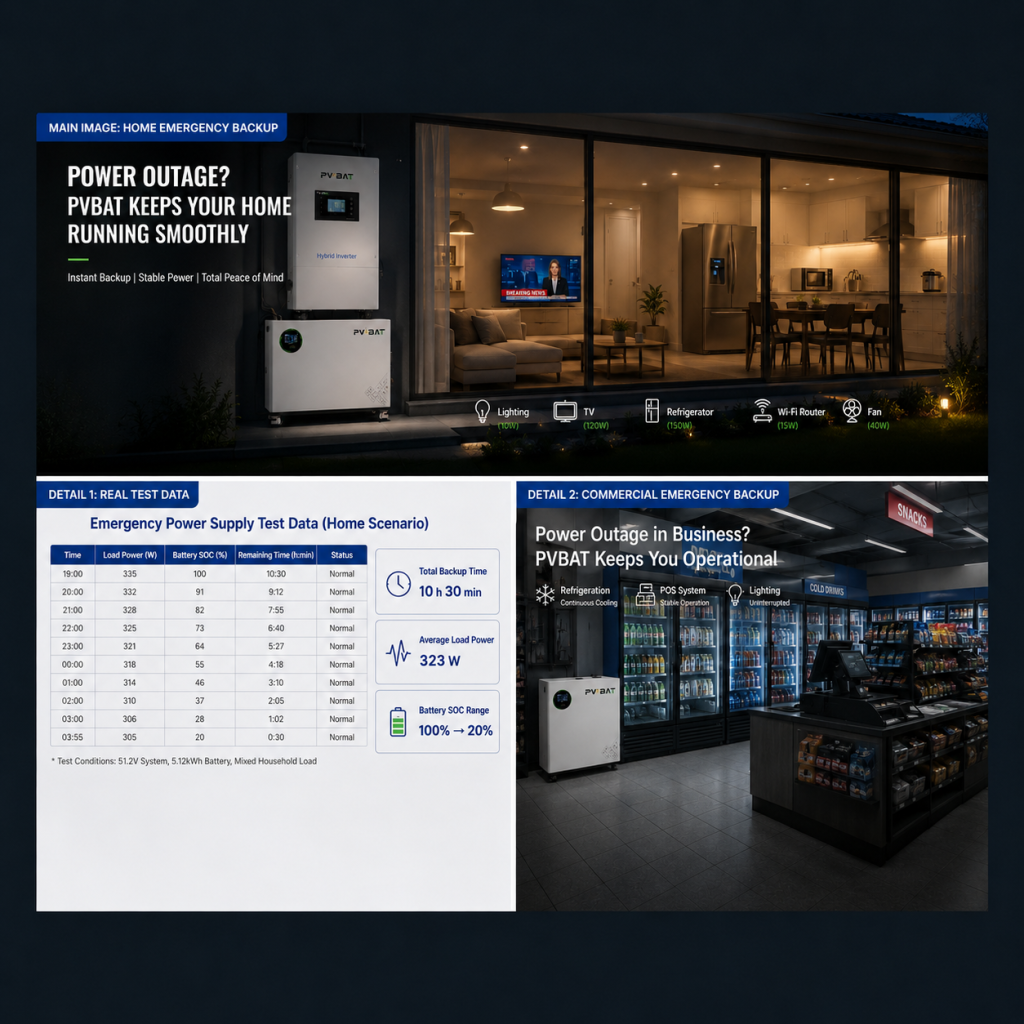
Test results demonstrate that the PVBAT energy storage system delivers stable and reliable emergency power supply, featuring fast switching and extended runtime. It effectively addresses power outages in various scenarios—including residential, commercial, and outdoor settings—providing users with peace of mind through assured emergency power protection. This capability represents one of the core competitive advantages of PVBAT products, establishing the brand as a trusted provider of emergency energy storage solutions.