

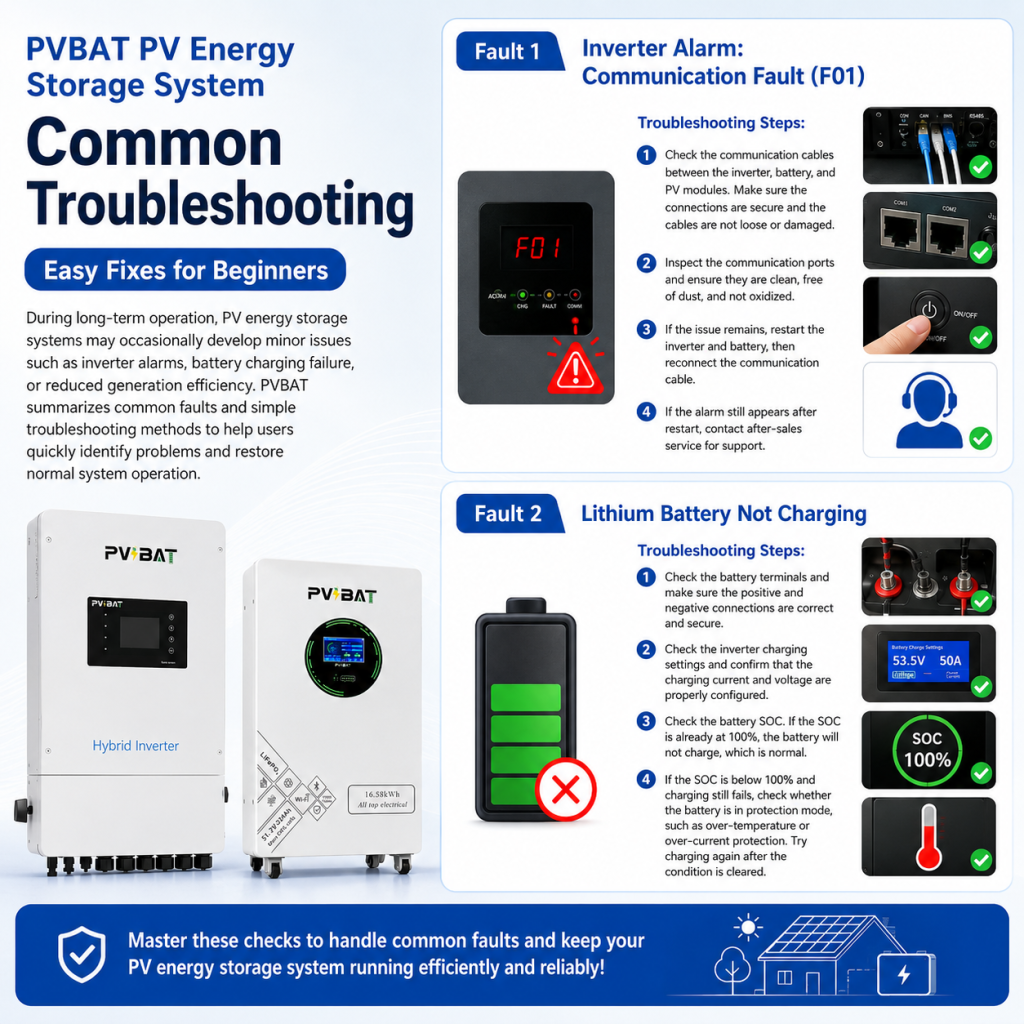
During long-term operation, photovoltaic energy storage systems are bound to experience minor malfunctions, such as inverter alarms, batteries failing to charge, and decreased power generation efficiency. When faced with these issues, many users are unsure how to troubleshoot them and can only wait for service engineers, which wastes time and disrupts normal use. PVBAT has compiled a list of common system faults and troubleshooting methods that are simple and easy to understand, even for beginners, helping users quickly resolve minor issues and restore normal system operation. We provide a PV storage troubleshooting guide to empower beginners to perform self-diagnosis and resolve common PV storage faults.
Fault 1: Inverter alarm displaying “Communication Fault (F01).” Troubleshooting steps: Inspect the communication cables between the inverter and the batteries/PV panels to ensure connections are secure, with no loose or damaged cables; Inspect the communication ports to ensure they are free of dust and oxidation, preventing poor contact; if the issue persists, restart the inverter and battery, then reconnect the communication cables; if the alarm persists after restarting, contact an after-sales engineer to resolve the inverter communication failure.
Fault 2: Lithium battery not charging. Troubleshooting: Inspect the lithium battery terminals to ensure positive and negative connections are correct and secure, avoiding reverse polarity; Check the inverter’s charging parameters to ensure the charging current and voltage are set appropriately; Check the lithium battery’s SOC. If the SOC has reached 100%, charging will not occur (this is normal); If the SOC is below 100% and charging still does not occur, check whether the lithium battery is in a protection state (e.g., over-temperature or over-current protection). Wait until the fault is resolved before attempting to charge again to resolve the issue of the energy storage lithium battery not charging.